mindzieStudio On-Premise Installation Guide
Overview
mindzieStudio's AI-Driven Process Mining and Automation platform offers a comprehensive and in-depth understanding of an organization's workflows within your organization, providing unparalleled visibility into processes, identifying bottlenecks, inefficiencies, and areas for optimization. By leveraging process mining tools, users can gain real-time insights, enabling them to streamline operations, improve compliance, and enhance overall efficiency. mindzieStudio empowers organizations to make data-driven decisions, optimize processes for maximum productivity, reduce operational costs, accelerate process execution, and ensure a seamless, standardized workflow across their enterprise.
Key Benefits
- Improve Process Times - Optimize workflows for faster execution
- Reduce Waste - Identify and eliminate inefficiencies
- Monitor and Ensure Compliance - Maintain regulatory standards
Installation Type
This guide covers both online and offline installations. Choose based on your environment:
| Installation Type | When to Use |
|---|---|
| Online | Server has internet connectivity |
| Offline | Server has no internet access (air-gapped) |
For offline installations, all required files must be downloaded on a machine with internet access and transferred to the target server.
Pre-Installation Checklist
Complete all items below BEFORE your scheduled installation. Print this page and check off each item.
SSL Certificate
- SSL certificate obtained from IT/Security department
- Certificate file(s) ready for import into IIS
- Certificate matches the planned domain name
DNS Configuration
- DNS entry created (e.g.,
mindzie.[yourcompany].com) - DNS record points to the VM's IP address
- DNS propagation verified (can resolve the hostname)
SQL Server (Choose One)
Option A: Use Existing SQL Server
- SQL Server instance identified and accessible from the VM
- Database administrator available who can:
- Create a new database called "mindzie"
- Create appropriate login with db_owner permissions (see Authentication Mode below)
- Provide connection credentials
- Authentication mode determined (see next section)
Option B: Install SQL Server Express on the VM
- SQL Server Express installer available (download if online, or transfer if offline)
- IT person available to install SQL Server Express
- Understood: SQL Express is free but lacks enterprise features (backup, mirroring)
- See Install SQL Server Express guide
SQL Server Authentication Mode
Choose one of the following authentication modes:
| Mode | Requirements | Best For |
|---|---|---|
| Mixed Mode (SQL Server + Windows Auth) | SQL login with username/password | Recommended. Simpler setup - the Windows Service and the IIS application pool can stay on the default Local System account |
| Windows Authentication Only | A Windows service account with SQL permissions, used by both the Windows Service and the IIS application pool | Environments whose security policy does not permit SQL logins |
For Mixed Mode:
- SQL Server has Mixed Mode authentication enabled
- SQL login credentials will be created (username/password)
For Windows Authentication Only:
- Windows service account identified or will be created
- Service account will have db_owner access to mindzie database
- Permission to configure both the Windows service and the IIS application pool to run under this account
- Service account will be granted read/write access to the IIS website, service, and storage directories (see Step 4)
Virtual Machine
- Windows Server 2019 or later provisioned
- Meets minimum specs: 4+ cores, 8GB+ RAM, 100GB+ storage (see Technical Requirements)
- Administrator with full access available for:
- Installing software
- Configuring IIS
- Managing Windows services
- Internet connectivity available (for online installation only)
Additional Items
- mindzieStudio license key received from mindzie
- Scheduled downtime window communicated to users (if applicable)
Offline Installation Only
If your server has no internet access, you will need to download files during Steps 3 and 4 below on a machine with internet, then transfer them to the target server (via USB drive, network share, etc.).
Installation Steps
Step 1: SQL Server Configuration
Requirements:
- Permission to create databases on your SQL server
- SQL Server Management Studio (recommended)
Setup Process:
- Launch SQL Server Management Studio
- Create the mindzie database with the correct collation
IMPORTANT: Database Collation Requirement
The mindzie database must be created with the collation SQL_Latin1_General_CP1_CI_AS. This collation is required for correct string comparisons throughout the application.
Download the database creation script:
Download create-mindzie-database.sql
To use the script:
- Open SQL Server Management Studio
- Connect to your SQL Server instance
- Open the downloaded script file
- Execute the script (F5)
The script will:
- Verify the database doesn't already exist
- Create the mindzie database with the correct collation
- Display confirmation of the collation setting
Then choose based on your authentication mode:
If Using Mixed Mode (SQL Server Authentication)
- Ensure SQL Server has Mixed Mode authentication enabled
- Create a SQL login called "mindzie"
- Grant the "mindzie" login db_owner access to the "mindzie" database
If Using Windows Authentication Only
- Identify or create a Windows service account (e.g.,
DOMAIN\mindzieService) - In SQL Server, create a login for this Windows account
- Grant the Windows login db_owner access to the "mindzie" database
- Note: In Step 4 you will configure both the mindzieStudio Windows Service and the IIS application pool to run under this account
Step 2: Internet Information Services (IIS)
Configuration:
- Make sure the server has IIS enabled prior to installing .NET
- If you already installed .NET then please repair the .NET install
- Add "WebSocket Protocol" under Web Server -> Application Development
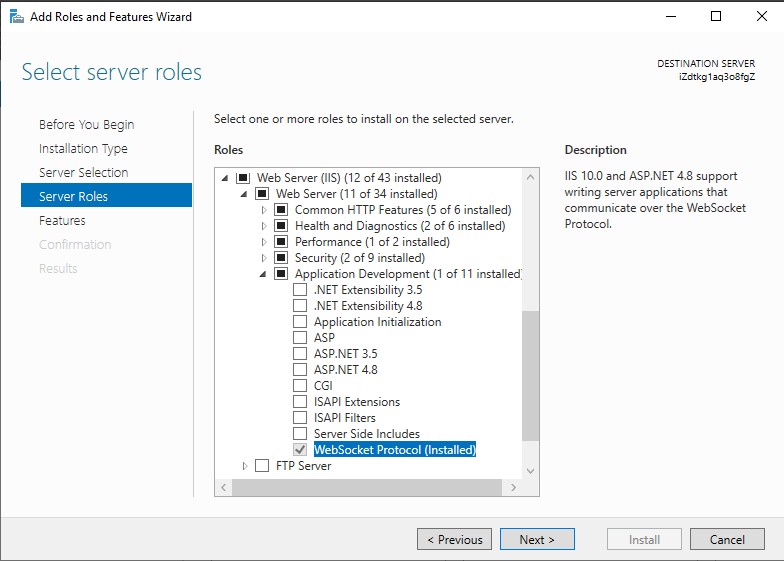
Note: Ensure IIS is properly configured before proceeding to the next step.
Step 2a: Remove WebDAV
WebDAV must be removed from the server. This feature intercepts HTTP requests (PUT, DELETE, MOVE) before they reach mindzieStudio, causing API failures.
Open PowerShell as Administrator and run:
Remove-WindowsFeature Web-DAV-Publishing
A server restart may be required. See Disable WebDAV for full details.
Step 3: .NET Runtime Installation
Online Installation
Download and install ASP.NET Core 8 Runtime Hosting Bundle:
Download ASP.NET Core 8 Runtime Hosting Bundle
Run the installer and follow the wizard to complete installation.
Offline Installation
Download the hosting bundle on a machine with internet access, then transfer to the server:
Download ASP.NET Core 8 Runtime Hosting Bundle
On the server:
- Locate
dotnet-hosting-8.0.6-win.exe - Run the installer as Administrator
- Follow the installation wizard
- Restart IIS after installation completes
Step 4: Install mindzieStudio
Online Installation
Download mindzieStudio Enterprise Edition:
Run the Installation:
- Execute
mindzieStudioSetup.exe - Accept the License Agreement
- Leave all screens as the defaults
Offline Installation
Download the following files on a machine with internet access, then transfer all three to the server:
1. Download mindzieStudio Setup
2. Download mindzieStudio Update Package
On the server:
- Place all three files in the same directory
- Execute
mindzieStudioSetup.exe - Accept the License Agreement
- Leave all screens as the defaults
License Configuration (All Installations)
- After installation, run the
EnterpriseConfigurationapp - Paste your license into the text box and click "Activate New License"
Database Configuration
- Click the "Database Settings" button
- Click "Change SQL Server"
- Configure based on your authentication mode:
If Using Mixed Mode (SQL Server Authentication):
- Ensure the correct SQL Server name is entered
- Set Authentication to "SQL Server Authentication"
- Enter the SQL username and password
- Click "Update Database"
If Using Windows Authentication Only:
- Ensure the correct SQL Server name is entered
- Set Authentication to "Windows Authentication"
- Click "Update Database"
- Then change both service accounts as described below
Critical: there are TWO accounts to change, not one
Under Windows Authentication, mindzieStudio connects to SQL Server from two separate places, each with its own identity:
- the mindzieStudioService Windows Service, and
- the mindzieStudioAppPool IIS application pool.
After a fresh install both run as Local System, which has no access to SQL Server. Changing one does not change the other. If you change only the Windows Service - the most common mistake - the site will still fail to start.
To change both accounts:
- In the Enterprise Configuration tool, find the Service / IIS Status section and click Settings...
- The dialog contains two independent sections, each with its own Change Account... button - one headed Windows Service: mindzieStudioService, the other IIS Application Pool: mindzieStudioAppPool. Both must be set to the same Windows service account.
- For each section in turn, click Change Account..., choose Custom Account (recommended for Windows Auth), enter the account name and password, and click OK.
- Confirm the Account field in both sections now shows your service account. If either still reads
LocalSystem,NT AUTHORITY\SYSTEM, orApplicationPoolIdentity, it has not been changed.
You can also set the Windows Service account from Windows Services (services.msc) ->
right-click mindzieStudioService -> Properties -> Log On tab. There is no equivalent
in services.msc for the application pool - change it in the Configuration tool, or in
IIS Manager -> Application Pools -> mindzieStudioAppPool -> Advanced Settings ->
Identity.
Permissions the service account needs:
| Requirement | Where it is granted |
|---|---|
SQL login with db_owner on the mindzie database |
SQL Server (Step 1) |
| Read/write access to the IIS website directory | Windows folder permissions |
| Read/write access to the service directory | Windows folder permissions |
| Read/write access to the storage directory | Windows folder permissions |
The Configuration tool does not grant the folder permissions for you
When Windows Authentication is in use, the Settings dialog lists the three directories (IIS Website, Service, Storage) with their real paths on your server. It only displays them - it does not modify folder permissions. You must grant your service account read/write access to each of the three folders yourself.
Use an account with a stable password, or establish a procedure for updating the Windows Service and application pool credentials whenever the password changes - the site stops working once the stored password is out of date.
Verify the Database Configuration
Confirm the installation actually works before handing the server over:
- The Windows Service reaches "Running". In the Settings dialog, or in
services.msc, the status of mindzieStudioService must readRunning. A status stuck atStartPending, or one that returns toStoppedshortly after starting, means the account cannot open the database. - The application pool is Started, and its Account shows your service account.
- The site loads. Browse to the mindzieStudio URL and sign in. A start-up database failure produces an error page instead of the sign-in screen.
A successful "Check" does not prove the configuration is correct
In the database dialog, the Check button confirms that a connection to the SQL
Server succeeds. It does not confirm access to the mindzie database, and it
connects as the account you are signed in with while running the Configuration tool -
not as the Windows Service or application pool account. Check can therefore succeed
while the service account still has no rights on the mindzie database. Only a
Running service and a site that loads prove the configuration is correct.
Step 4a: Install Python (Optional)
If you plan to use Python enrichments or Python Script actions, install Python now.
When is Python Required?
Python is only required if you want to use:
- Python Enrichment - Custom data transformations using Python scripts
- Python Script Action - Automated integrations, webhooks, database exports, notifications
If you do not plan to use these features, skip this step.
See Install Python for detailed installation instructions.
Step 5: Configure SSL in IIS
SSL Configuration:
- Configure SSL Certificate in Internet Information Services (IIS)
- Add https binding using the SSL certificate from step 1
- This should not be localhost for production installations
Recommended DNS:
mindziestudio.[companyname].com
Important Notes:
- SSL configuration is required for production environments
- Ensure proper certificate management for security
Updates
Online Servers (Auto-Update)
Servers with internet connectivity can use automatic updates. See Auto Update for configuration details.
Offline Servers (Manual Update)
When updates are available for offline servers, download the latest files and run the setup again.
Required Downloads for Update:
1. Download mindzieStudio Setup
2. Download mindzieStudio Update Package
Update Process:
- Download all three files above on a machine with internet access
- Transfer the files to the server
- Place all three files in the same directory on the server
- Run
mindzieStudioSetup.exe- the setup will handle everything automatically
Additional Configuration
Upgrades
When upgrading your Enterprise server, note that you will need to re-add your certificate to the website in IIS.
Licensing Updates
If you have upgraded your license, you will need to take the following steps for it to take effect:
- Run the Enterprise Configuration tool and click refresh license
- Restart the mindzie website in IIS
LLM AI Integration
To utilize an on-premise LLM for mindzie's AI copilot and other features, please contact support@mindzie.com for details.
Troubleshooting
"Cannot open database mindzie requested by the login. Login failed for user 'NT AUTHORITY\SYSTEM'"
Symptom: The installation completed and the licence is valid, but the site fails at start-up with an error similar to:
SqlException 4060: Cannot open database "mindzie" requested by the login.
Login failed for user 'NT AUTHORITY\SYSTEM'.
Cause: You chose Windows Authentication, but the mindzieStudio Windows Service and/or
the IIS application pool are still running as Local System. NT AUTHORITY\SYSTEM is
the Local System account, and it has no login on your SQL Server. The database itself is
fine - the application simply has no identity permitted to open it. This most often
happens when only the Windows Service account was changed and the mindzieStudioAppPool
application pool was left on its default.
Fix:
- Open the Enterprise Configuration tool -> Service / IIS Status -> Settings...
- Read the Account shown in both sections. Any value of
LocalSystem,NT AUTHORITY\SYSTEM, orApplicationPoolIdentityis the problem. - Use Change Account... in each section to set your Windows service account. Both must be changed - see Step 4, Database Configuration.
- Confirm the account has a SQL login with db_owner on the
mindziedatabase (Step 1). - Grant the account read/write access to the IIS website, service, and storage directories - the Configuration tool lists these paths but does not set the permissions.
- Restart the Windows Service and recycle the application pool, then reload the site.
If the error names your service account (for example Login failed for user 'DOMAIN\mindzieService'), the identity change worked, but that account has no db_owner
rights on the mindzie database. Correct it in SQL Server as described in Step 1.
Simpler alternative
If your security policy permits SQL logins, use SQL Server Authentication instead. Both the Windows Service and the IIS application pool can then remain on the default Local System account, and no folder permissions or password-rotation procedure are required. Windows Authentication remains fully supported for environments where SQL logins are not allowed.
Service Will Not Start After Configuration
If mindzieStudioService stays at StartPending or stops again immediately, the
service account almost always cannot reach the database. Work through the steps above,
and remember that a successful Check in the database dialog only validates the
connection to the SQL Server - not access to the mindzie database, and not from the
service account.
Support
Need help with your installation? Contact us:
Email: support@mindzie.com
Our support team is here to help with any installation or configuration questions.
For technical specifications and requirements, see the Technical Requirements page.